
Running a restaurant business means balancing numerous factors to ensure profitability and sustainability. One of the most critical financial metrics every owner must understand is the break-even point. Knowing your break-even point helps determine when your restaurant will finally begin generating profit after covering all expenses.
At Hildreth & Puga CPAs, we specialize in accounting for restaurant business operations, helping owners navigate the challenges of accounting in restaurant industry environments. From financial reporting and payroll to advisory support and tax planning, our team provides practical guidance tailored specifically to restaurants and multi-unit operators. This blog explains how to calculate your break-even point and why strong accounting for restaurant operations is essential for long-term profitability.
Understanding Break-Even Metrics in Accounting for Restaurant Business
Your restaurant’s break-even point is the level of sales at which total revenues equal total expenses—meaning your net income is zero. At this point, all fixed and variable costs are covered. Once you surpass the break-even point, your restaurant begins to make a profit.
Understanding this metric enables you to make data-driven decisions on menu pricing, cost control, staffing, and expansion.
Fixed Costs vs. Variable Costs in Restaurant Accounting
To calculate your break-even point, you must distinguish between fixed and variable costs:
- Fixed Costs: These are expenses that remain constant regardless of sales volume. Examples include rent, insurance, property taxes, and salaried staff wages.
- Variable Costs: These fluctuate directly with sales volume, such as food and beverage costs, hourly labor wages, and utilities linked to production.
Accurate tracking and categorization of these costs through effective accounting for restaurant business is vital. Our Bookkeeping & Payroll Services aid in maintaining clear and organized accounts.
Contribution Margin and Its Role in Break-Even Analysis
Contribution margin represents how much money from each sale contributes toward covering fixed costs and profit generation after covering variable costs.
Formula:
Contribution Margin = Revenue per Unit – Variable Cost per Unit
A higher contribution margin means you can reach your break-even point faster.
How to Calculate Your Break-Even Point
Several formulas exist to calculate the break-even point, depending on your preferred measurement—units sold or sales dollars.
Break-Even Point in Units
This formula calculates the number of individual sales (e.g., meals served) needed to break even:
Break-Even Point (Units) = Total Fixed Costs ÷ (Revenue per Unit – Variable Cost per Unit)
For restaurants, the “unit” typically refers to one customer purchase or meal.
Break-Even Point in Sales Dollars
This measures how much total dollar sales you need to reach break-even:’
Break-Even Point (Sales $) = Total Fixed Costs ÷ Contribution Margin Ratio
Where Contribution Margin Ratio = Contribution Margin per Unit ÷ Revenue per Unit
Using these calculations requires accurate financial reports, which is where expert accounting for restaurant business plays a key role. Our restaurant accountants ensure your data is clean, precise, and actionable.
Why Knowing Your Break-Even Point Matters
Tracking your break-even point provides actionable insights that influence strategic decisions:
- Pricing Strategy: Understanding costs helps set prices that cover expenses while attracting customers.
- Cost Control: Pinpointing fixed and variable costs allows better management to improve margins.
- Financial Forecasting: Knowing when profitability begins guides budgeting and investment.
- Risk Management: Assists in evaluating the viability of new menu items or locations.
Successful accounting in restaurant industry environments depends on more than bookkeeping alone. Restaurant owners need clear visibility into operating costs, labor performance, pricing strategy, and cash flow to make informed financial decisions.
Case for Professional Accounting in the Restaurant Industry
Many restaurant owners struggle because they lack strong systems for accounting for restaurant business operations. Without organized reporting, accurate bookkeeping, and proactive financial guidance, it becomes difficult to control costs, monitor profitability, and scale sustainably. Professional support in accounting for restaurant operations helps owners gain clearer financial visibility and stronger decision-making confidence.
Our accounting for restaurant services help bridge this gap by providing:
- Detailed financial analysis
- Accurate break-even calculations
- Ongoing advisory support
You can explore more about our tax strategies tailored for the food service industry in our Tax Preparation & Planning services.
Common Financial Challenges in Accounting for Restaurant Business
Restaurant owners face unique financial challenges that require specialized accounting support. High food costs, labor fluctuations, inventory waste, seasonal demand shifts, and multi-location reporting can quickly impact profitability when financial systems are not properly managed.
Strong accounting for restaurant business operations helps owners monitor margins, improve forecasting accuracy, manage payroll efficiently, and maintain compliance across locations. In today’s competitive market, effective accounting in restaurant industry environments plays a major role in long-term operational success.
The Role of Technology Integration in Accounting for Restaurant Business
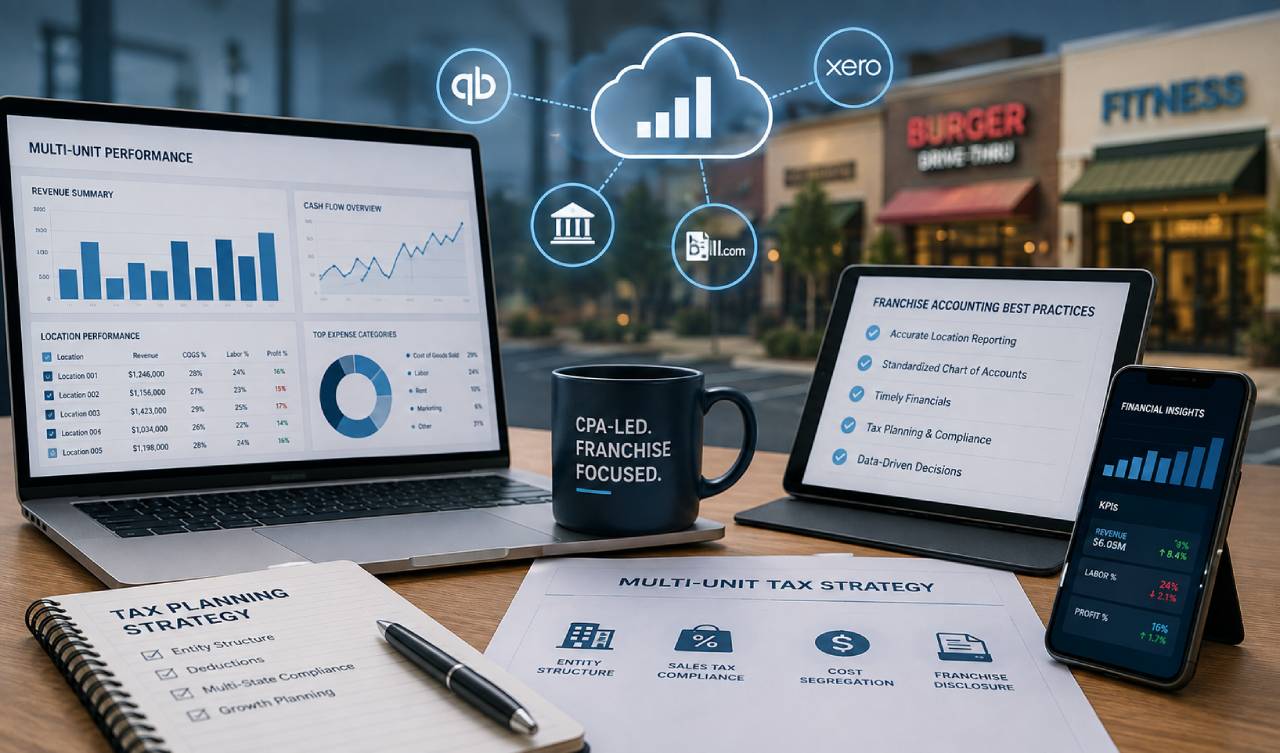
In today’s restaurant industry, technology integration is revolutionizing how accounting for restaurant business operations are managed. Modern accounting software, when seamlessly connected with Point of Sale (POS) systems, payroll platforms, inventory management, and vendor tracking tools, enables restaurant accountants to deliver real-time financial insights critical for effective decision-making.
Benefits of Integrated Restaurant Accounting Solutions
Integrating your accounting system with restaurant operational technology offers multiple advantages:
- Real-Time Financial Updates: POS transactions automatically sync with your accounting software, providing accurate, up-to-the-minute data on sales, expenses, and cash flow. This reduces manual entry errors and keeps your financial reports current.
- Streamlined Operations: Integration eliminates duplicate data entry by syncing sales, vendor invoices, employee hours, and inventory usage. This burnout reduction means your team can focus on restaurant operations rather than chasing paperwork.
- Comprehensive Reporting: Integrated data enables detailed and customizable reporting combining financial and operational metrics, such as food cost ratios, labor efficiency, and sales trends. This holistic view improves your ability to manage costs and profit margins effectively.
- Improved Compliance and Audit Readiness: Real-time, accurate records foster smooth tax compliance and simplify audits, reducing risk and stress.
How Hildreth & Puga CPAs Leverage Technology
At Hildreth & Puga CPAs, our restaurant accountants utilize advanced cloud-based platforms integrated with your POS and management systems. This setup allows us to:
- Perform prompt and precise reconciliations.
- Quickly identify cost-saving and efficiency opportunities.
- Provide interactive dashboards and alerts for essential financial metrics.
Coupled with our comprehensive Bookkeeping & Payroll Services and Tax Preparation & Planning, our technology-enhanced approach ensures your accounting remains accurate and insightful.
Empowering Growth Through Technology
Adopting integrated accounting systems is a strategic move for any restaurant seeking sustainable growth and operational excellence. We assist in selecting ideal platforms tailored to your restaurant’s complexity, making the transition seamless.Our Free Bookkeeping Diagnostic Review for Multi-Unit Franchise Operators provides a thorough evaluation of your current financial processes and alignment with technology solutions to meet your unique needs.
Get Your Free Franchise Bookkeeping Toolkit
Take control of your franchise finances with our free toolkit. Inside, you’ll find a monthly close checklist, a list of tasks to delegate, and practical tips for managing multiple locations more efficiently.

Why Strong Restaurant Accounting Matters
Understanding your break-even point is only one piece of building a financially healthy restaurant. Long-term success requires organized financial systems, accurate reporting, proactive tax planning, and strategic decision-making support.
At Hildreth & Puga CPAs, we provide accounting for restaurant business operations designed to help owners improve financial visibility, control costs, and support sustainable growth with confidence. If you’re looking for proactive financial guidance tailored to your restaurant operations, contact our team to learn how we can help.
FAQs
What is the importance of knowing my restaurant’s break-even point?
It helps you know how much you need to earn to cover costs, guiding pricing and operational strategies—critical for profitability.
How do fixed and variable costs impact restaurant accounting?
Fixed costs stay constant regardless of sales, while variable costs fluctuate. Proper accounting distinguishes these to inform financial decisions.
Can Hildreth & Puga CPAs help me with break-even calculations?
Absolutely. Our restaurant accountants provide precise financial analysis and reporting to determine your break-even point accurately.
What accounting services for restaurants do you offer?
We provide comprehensive services including bookkeeping, payroll, tax planning, and business advisory, all tailored to restaurant needs.
Can Hildreth & Puga CPAs help me with break-even calculations?
Absolutely. Our restaurant accountants provide precise financial analysis and reporting to determine your break-even point accurately. For more insights on managing your restaurant’s finances and seasonal fluctuations, please see our blog on Restaurant Bookkeeping Services: Navigating Seasonality In Your Business.
What accounting services for restaurants do you offer?
We provide comprehensive services including bookkeeping, payroll, tax planning, and business advisory, all tailored to restaurant needs. You might also find valuable tips in our blog on Bookkeeping For Restaurants: Preventing Cash Leaks Before They Happen.
How often should I review my break-even point?
Regular review—monthly or quarterly—is recommended to respond to changing costs and sales dynamics.
Can I customize your accounting services to fit my restaurant’s size and type?
Yes, we create personalized accounting solutions to fit single restaurants or multi-unit franchises.
Does knowing my break-even point help in controlling costs?
Yes, it highlights where earnings cover costs and where you can focus on reducing expenses or boosting revenue.improvement.
What makes accounting for restaurant business different from other industries?
Accounting for restaurant business operations involves unique financial challenges such as fluctuating food costs, labor expenses, inventory management, tip reporting, and narrow profit margins. Restaurants also process a high volume of transactions daily, making accurate financial reporting and cost tracking essential for long-term profitability.
Why is accounting in restaurant industry operations more complex?
Accounting in restaurant industry environments is more complex because restaurants must manage changing food costs, payroll, inventory, vendor payments, and sales reporting all at once. Without organized financial systems, it becomes difficult to accurately track profitability and control expenses.
How can professional accounting for restaurant owners improve profitability?
Professional accounting for restaurant owners helps improve financial visibility, identify cost-saving opportunities, and support better decision-making. Accurate reporting and proactive financial guidance can help restaurant owners manage cash flow, reduce unnecessary expenses, and improve long-term profitability.
What should restaurant owners track financially each month?
Restaurant owners should track revenue, food costs, labor expenses, payroll, cash flow, inventory, and profit margins each month. Regular financial reporting helps identify trends, manage costs, and improve operational decision-making.
Why is break-even analysis important in accounting for restaurant business?
Break-even analysis helps restaurant owners understand how much revenue is needed to cover operating expenses before generating profit. In accounting for restaurant business operations, this insight supports better pricing, budgeting, staffing, and financial planning decisions.